Navier-Stokes Solved?
It was announced today by OpenAI that they are sharing a solution to the Navier-Stokes problem. The Millennium Prize Problems are seven complex mathematical problems, selected in the year 2000, with each one representing a prize of one million US dollars to the first correct solution. The first prize was awarded in 2010 to Grigori Perelman for his proof of the Poincaré conjecture, although he chose to decline the prize money. The Navier-Stokes existence and smoothness problem, asks about the properties of the Navier-Stokes equations, which are essentially the governing equations of fluid mechanics. The full paper has been posted here. Now, I’m in no position to give any useful or interesting feedback on this result. But I’m more interested in talking about the apparent way in which the result came about.
The claims going around are that Tristan Buckmaster (NYU) and Levent Alpöge (Anthropic) had been making strides towards solving the problem themselves, and using codex to help their research. After word of their work reached OpenAI, an internal team was set on the problem with an “insane amount of compute”, by OpenAI’s own account. Buckmaster and Alpöge had been putting all of their drafts into Codex, and when Buckmaster asked whether the model had been trained on those sessions, he didn’t get an answer. OpenAI then offered him two deals: post their result and let OpenAI follow with Navier-Stokes the next day, or write up the Navier-Stokes result himself, crediting an internal OpenAI model, on the condition that Alpöge, who works at Anthropic, be removed from authorship. In exchange, OpenAI would say publicly that the pair “deserved the Clay Prize”. He declined both. When he said he’d go public, the reply was “Why would you ruin your career?” and, later, “If you don’t want me to be nice, then I don’t have to be nice.” Obviously, there’s a lot to read into here.
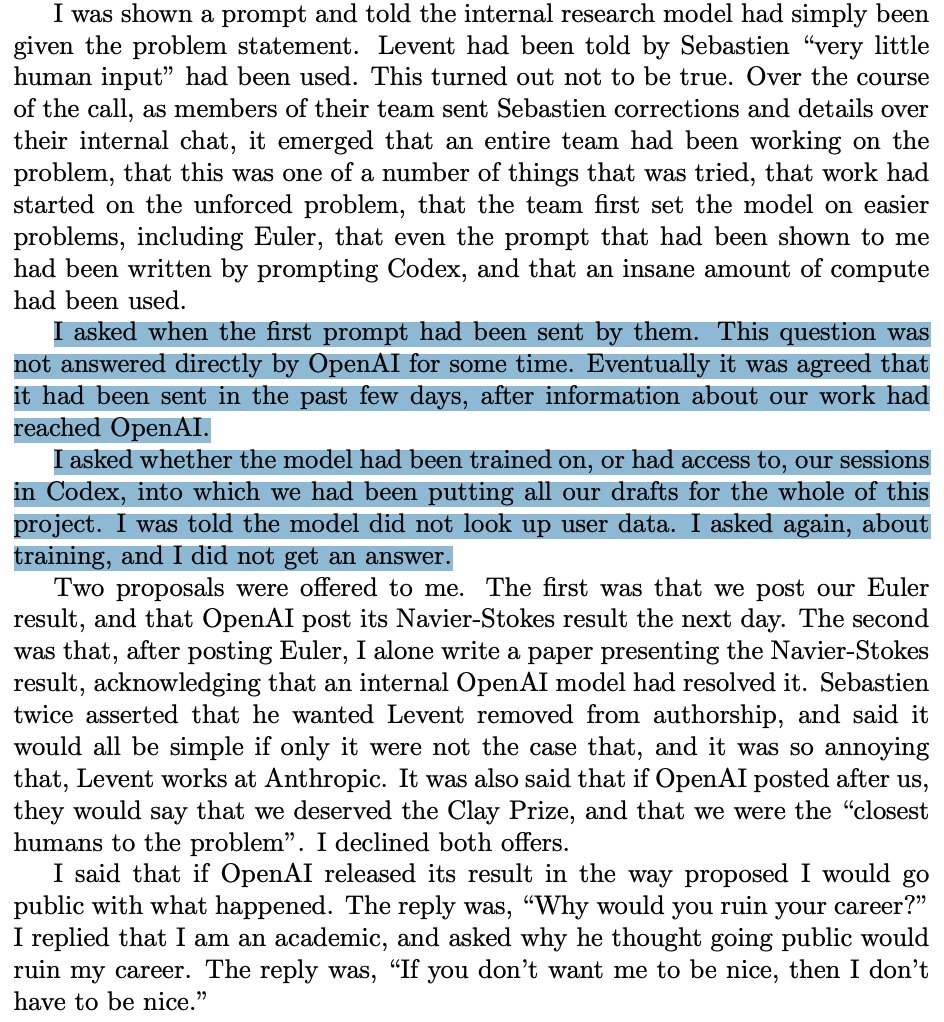
Now if that is indeed an accurate version of what happened, the implications are profound. Imagine that every time a researcher is making big progress on an important problem, a big AI company takes notice of it and uses their work to push it foward with their much larger computational capability and take credit themselves. That could be the reality we are heading towards. In that case, is it time for university departments to start hosting their own private language models whose data privacy they can control? Are researchers going to have to start being a lot more secretive about their work, when academia is very much based around collaboration? There’s a lot to think about here.
Update: 24 Fields medal winners have signed an open letter, titled “A Severe Misalignment of AI in Mathematics”. In it, they note that “the push by AI companies to solve mathematical problems as a benchmark is detrimental to the science of mathematics, and to the mathematical community”. The reasoning presented is that “solving problems [is] only a tool and proxy for achieving the primary goal of conceptual understanding and insight”, while also noting that the solutions are announced in a rush. Personally, I am in full agreement with what they are saying here. The beauty of mathematics is in concepts, ideas and ways of understanding, not in specific results. Can AI ever produce these kinds of new concepts? We’ll have to see, I suppose.